React vs WordPress: An Honest Comparison for Business Owners
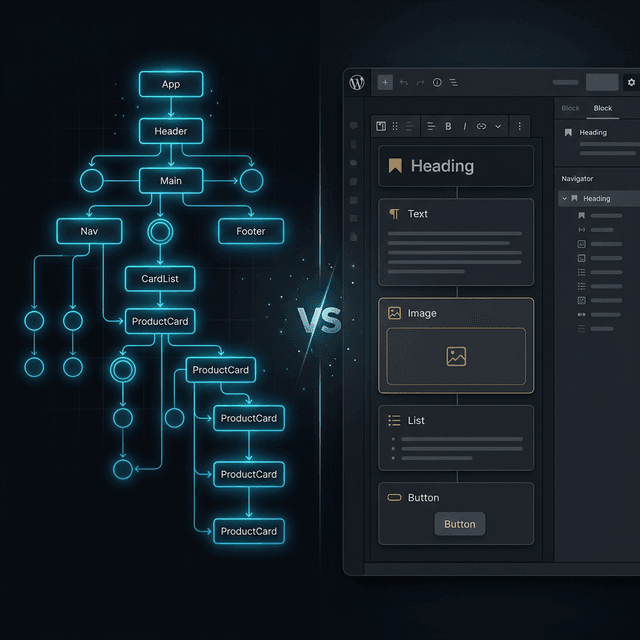
React vs WordPress: An Honest Comparison for Business Owners
If you've ever Googled "build a website," you've been told to use WordPress. And for good reason — WordPress powers roughly 40% of the entire internet. But powering 40% of the internet doesn't mean it's the best tool for your business.
Let's cut through the noise.
What WordPress Does Well
WordPress earned its dominance for legitimate reasons:
- Ease of use. Non-technical users can manage content through a visual editor.
- Plugin ecosystem. There's a plugin for almost everything — contact forms, SEO, e-commerce, analytics.
- Community. Millions of developers, thousands of themes, and decades of documentation.
- Low initial cost. You can get a WordPress site running for under $100.
For a personal blog or a simple brochure site that doesn't need to compete on performance, WordPress is perfectly adequate.
Where WordPress Falls Apart
But "adequate" isn't what modern businesses need. Here's where WordPress starts to break:
Performance
A typical WordPress site loads 60+ HTTP requests and 2-4MB of assets on the initial page load. Most of this is bloated plugins, unused CSS from themes, and render-blocking JavaScript. The result? Lighthouse scores in the 40-70 range.
Google has been crystal clear: Core Web Vitals directly impact rankings. A WordPress site with 15 plugins will struggle to compete against a purpose-built React site scoring 95+.
Security
WordPress is the most targeted CMS on the planet. In 2025 alone, there were over 90,000 reported WordPress vulnerabilities. Every plugin you install is another attack surface. Updates break things. Outdated plugins get exploited.
React applications, by contrast, are compiled JavaScript bundles. There's no admin panel to hack, no plugin vulnerabilities to exploit, and no database directly exposed to the public internet.
Scalability
WordPress uses a traditional server-rendered PHP architecture. Every page request hits the database, processes PHP, and generates HTML on the fly. Under traffic spikes, this architecture buckles.
Modern React frameworks like Next.js use static generation and edge caching. Your pages are pre-built at deploy time and served from CDNs worldwide. A traffic spike? The CDN absorbs it effortlessly. Your server doesn't even notice.
Developer Experience
This one matters more than business owners realize. A happy developer writes better code, faster. WordPress development involves wrestling with PHP templates, hook-based architecture, and a legacy codebase that dates back to 2003.
React development is modern, component-based, and type-safe (with TypeScript). The developer experience is dramatically better, which translates directly into faster iterations and fewer bugs.
What React / Next.js Does Better
Here's what you get when you invest in a custom React build:
- Lighthouse 95-100 across Performance, Accessibility, Best Practices, and SEO
- Sub-second page loads through static generation and edge caching
- Zero plugin bloat — every feature is purpose-built
- Type safety — TypeScript catches bugs before they reach your users
- Component reusability — build once, use everywhere across your site
- Modern SEO architecture — dynamic sitemaps, structured data, proper meta handling
- Future-proof — React is backed by Meta and is the most popular UI library in the world
When To Choose WordPress
Be honest with yourself about your needs. WordPress might be the right call if:
- Your budget is genuinely under $2,000
- You need to publish content daily and don't have a developer on retainer
- Your site is purely informational with no complex functionality
- Performance and SEO ranking aren't competitive priorities
When To Choose React / Next.js
Choose a custom React build if:
- Your website is a revenue-generating asset, not just a digital business card
- You compete in a market where Google ranking matters
- You need custom functionality beyond what plugins can provide
- You care about brand perception — a fast, polished site signals a premium business
- You plan to scale with features like user portals, dashboards, or e-commerce
Our Recommendation
At Seamonster Coding, we build exclusively with Next.js and React. Not because WordPress is "bad" — but because our clients need to win. They need sites that load instantly, rank aggressively, and convert visitors into customers.
If you're competing in a market where every second of load time and every Google ranking position matters, a custom-engineered React site isn't a luxury — it's a necessity.
Ready to see what a purpose-built site can do for your business? Start a conversation with us.
Have a mission-critical project?
Stop settling for generic templates. Get a custom-engineered solution built for scale.
INITIATE PROJECT